
Architecture · Updated October 2026
Bosphorus Bridges Guide — All 3 Suspension Bridges
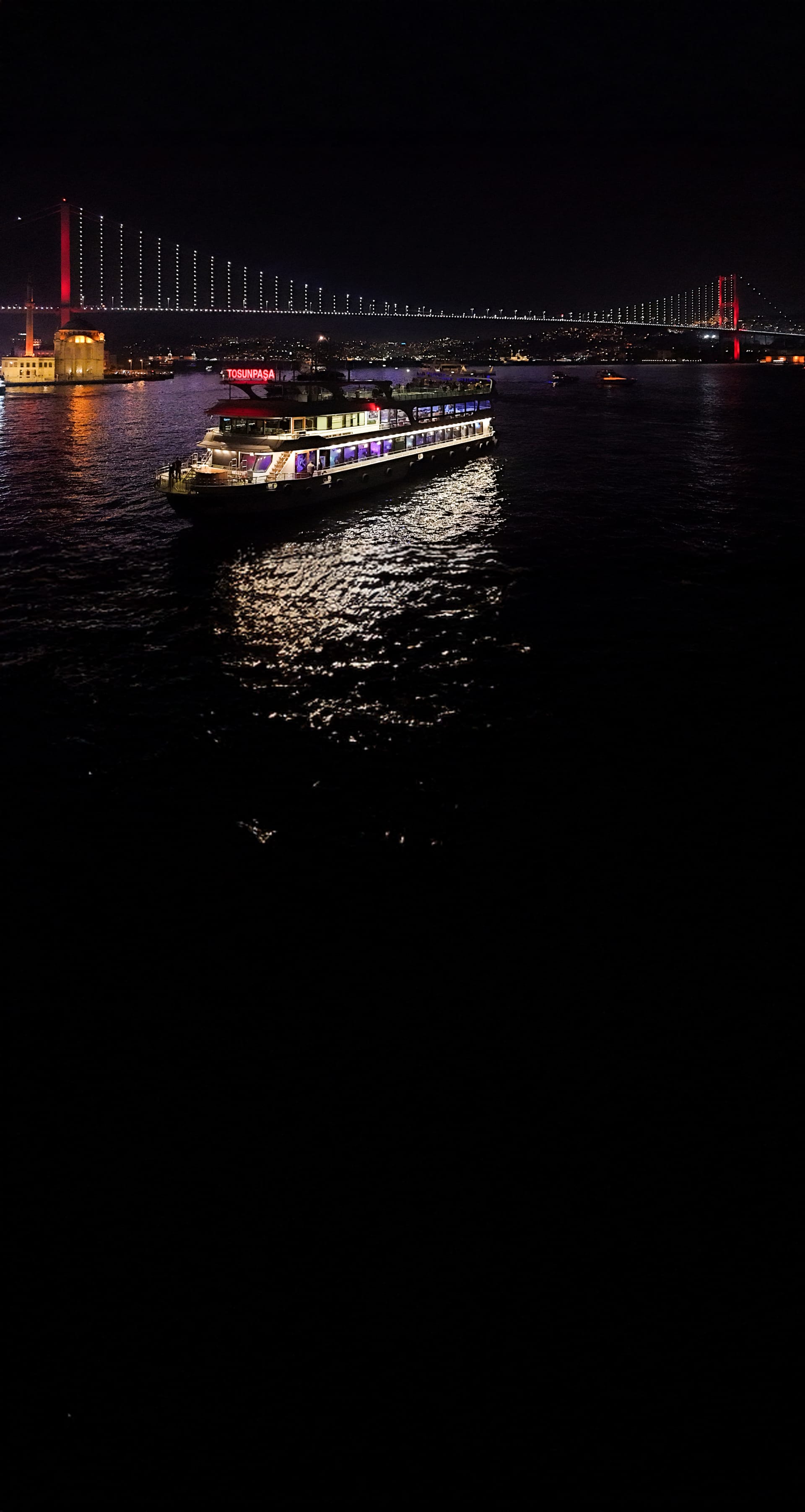
Three suspension bridges connect Europe and Asia across the Bosphorus strait — each from a different era, each with its own architectural personality, each illuminated at night in its own way. Together they are the most photographed engineering structures in Turkey, and the photographic highlight of any evening cruise on the strait. This guide walks through all three, with their history, technical details, illumination story, and the best places to see (and photograph) them from land and water.
See the Bridges From Below
3-hour Bosphorus dinner cruise: you sail under the illuminated 15 July Martyrs Bridge — twice — and turn in sight of the Fatih Sultan Mehmet Bridge. From €24.30, pay on the boat. Book Bosphorus Cruise →
In this guide
The 3 Bosphorus Bridges at a Glance
Three bridges, three eras. Here is how they compare side by side — and which of them you can see from a Bosphorus cruise.
| 15 July Martyrs Bridge | Fatih Sultan Mehmet Bridge | Yavuz Sultan Selim Bridge | |
|---|---|---|---|
| Opened | 1973 | 1988 | 2016 |
| Total length | 1,560 m | 1,510 m | 2,164 m |
| Main span | 1,074 m | 1,090 m | 1,408 m |
| Tower height | 165 m | 105 m | 322 m |
| Deck width | 33.4 m | 39 m | 58.5 m |
| Height above the water | 64 m | 64 m | 64 m |
| Carries | 6 lanes | 8 lanes | 8 lanes + railway |
| On our dinner cruise | We sail under it — twice | Seen from the water; the boat turns in front of it | Not on the route (far north) |
Bridge 1 · 1973 15 July Martyrs Bridge
The original Bosphorus Bridge — and still the most iconic. Connecting Ortaköy on the European side to Beylerbeyi on the Asian side. Until 2016 it was simply called Boğaziçi Köprüsü (Bosphorus Bridge); it was renamed in 2016 to commemorate those who died during the July 15th events.
It opened on 30 October 1973, the day after the 50th anniversary of the Turkish Republic, and became the first bridge of modern times to join the two shores of the Bosphorus. In July 2016 it was renamed the 15 July Martyrs Bridge, but most people — and most maps — still call it simply the Bosphorus Bridge. Its road deck hangs 64 metres above the water, high enough for the tankers and cruise ships that use the strait to pass beneath.
Specifications
- Length: 1,560 m total, 1,074 m main span
- Tower height: 165 m
- Deck: 33.4 m wide, 64 m above the water
- Construction: February 1970 – October 1973
- Design: Freeman Fox & Partners (UK) — engineers Gilbert Roberts and William Brown
- Traffic: about 180,000 vehicles a day
Architectural significance
When it opened in 1973, this was the longest suspension bridge in Europe and the fourth longest in the world. It was built using a similar design principle to the Severn Bridge in the UK. The two main towers are made of steel and the deck is suspended from steel ropes — a classic 1970s engineering aesthetic.
Lighting at night
Since April 2007 a computer-controlled LED system (by Philips) has lit the bridge with slowly changing colours and patterns. On national holidays it glows in the red and white of the Turkish flag, and on awareness days it takes on campaign colours — pink in October for breast-cancer awareness, for example. From the deck of a boat the effect doubles: every change of colour is mirrored on the water as you pass underneath.
Bridge 2 · 1988 Fatih Sultan Mehmet Bridge
The second bridge, located 5 km north of the first. Named after Sultan Mehmed II (the Conqueror), who took Constantinople in 1453. Connects Hisarüstü (European side) to Kavacık (Asian side). Slightly longer and significantly wider than the original.
Its European end rises right above Rumeli Hisarı, the fortress Sultan Mehmed II built in 1452 to control the strait before he took the city — so the bridge that bears his name stands over his own walls, close to the narrowest stretch of the Bosphorus. On our dinner cruise we do not pass under this bridge: the boat turns in front of it, neither right beneath it nor far away, close enough to take in the whole lit span between the two hillsides.
Specifications
- Length: 1,510 m total, 1,090 m main span (slightly longer than the first bridge's)
- Tower height: 105 m
- Deck: 39 m wide, 64 m above the water, 8 lanes
- Construction: March 1985 – July 1988
- Design: Freeman Fox & Partners with BOTEK; built by a Japanese–Italian–Turkish consortium
- Traffic: about 150,000 vehicles a day
Architectural significance
When it opened on 3 July 1988 it had the fifth-longest suspension span in the world. Its deck is noticeably wider than the first bridge's (39 m against 33.4 m), built for the commuter traffic that had grown between the two continents; pedestrians are not allowed on it. Seen from water level, its long, low line between the wooded hillsides is one of the most elegant shapes on the Bosphorus.
Lighting at night
An RGB LED system of about a thousand fittings can show 16 million colours. It is linked to the first bridge by a fibre-optic cable laid under the sea, so the two bridges can run synchronised light shows from a single control room — on national days you can see both glowing in the same colours along the strait.
Bridge 3 · 2016 Yavuz Sultan Selim Bridge
The newest and most northern crossing — built specifically to relieve the heavy commuter traffic on the older two bridges. Located far north of the city center near the Black Sea entrance to the Bosphorus. Named after Sultan Selim I (Yavuz Selim), the 16th-century Ottoman ruler.
Specifications
- Length: 2,164 m total, 1,408 m main span
- Tower height: 322 m — among the tallest bridge towers in the world
- Deck: 58.5 m wide — one of the widest suspension bridges ever built
- Type: hybrid cable-stayed suspension bridge
- Carries: 8 motorway lanes + a double-track railway
- Construction: May 2013 – August 2016
- Design: Michel Virlogeux and Jean-François Klein (T-ingénierie); built by İçtaş–Astaldi
Architectural significance
It connects Garipçe on the European side with Poyrazköy on the Asian side, close to where the Bosphorus meets the Black Sea. Its 322-metre towers are only a few metres short of the Eiffel Tower (330 m), and its deck carries both a motorway and a railway — an unusual combination for a bridge of this kind. It is part of the Northern Marmara Motorway, designed to keep heavy transit traffic out of the city centre.
Why most cruises do not pass under it
The Yavuz Sultan Selim Bridge stands roughly 25 km north of Kabataş, near the Black Sea entrance. Going there and back would take far longer than an evening cruise, so dinner cruises — ours included — do not go that far. Our route stays in the historic heart of the strait: under the 15 July Martyrs Bridge and up to the Fatih Sultan Mehmet Bridge, where the palaces, mosques and fortresses along the shore are lit at night.
Best Viewing Spots from Land
If you cannot get on the water, these are the best land-based viewpoints:
- Ortaköy Mosque square — perfect frame of the 15 July Martyrs Bridge with the small Ortaköy Mosque in the foreground. Most iconic Istanbul shot.
- Çamlıca Hill — Asian side, highest point. Both the 15 July and Fatih Sultan Mehmet bridges visible at once.
- Üsküdar coastline — view of the 15 July Martyrs Bridge from the Asian shore. Especially nice at sunset.
- Bebek seaside path — close-up view of the Fatih Sultan Mehmet Bridge.
- Rumeli Hisarı fortress — historic Ottoman fort directly under the Fatih Sultan Mehmet Bridge. Climb the walls for the bridge towering above you.
From the Water (Dinner Cruise)
The most spectacular way to experience the bridges is from below — passing directly underneath as you sail. The towers loom above, the lights reflect off the water, and the scale is genuinely awe-inspiring in a way photographs do not capture.
Our evening cruise leaves Kabataş and heads north along the European shore. From the very start you can see the 15 July Martyrs Bridge ahead, a line of light strung between two continents. As the boat slips past the floodlit façades of Dolmabahçe and Çırağan palaces, the bridge keeps growing: the towers rise, the cables come into view and the colours begin to ripple across the water.
About 40 minutes after departure, beside Ortaköy Mosque, you sail directly under it. For a few moments the underside of the road and the steel hangers fill the sky 64 metres above you, and the scale that photos never quite capture suddenly makes sense. Then turn around: the bridge behind you, with Ortaköy Mosque at its foot, is one of the most beautiful views of the evening.
The boat continues past Bebek and Rumeli Hisarı towards the Fatih Sultan Mehmet Bridge. We do not pass under this one — the boat turns in front of it, neither right beneath it nor far away, close enough to see its whole lit span stretched between the hillsides.
On the way back down the Asian shore, past Anadolu Hisarı and Beylerbeyi Palace, you pass under the 15 July Martyrs Bridge a second time — now from the other side, with the lights of the European shore behind it.
Insider tip — where to watch from
The views are lovely from everywhere on the boat, but the open upper deck is a different pleasure: fresh air, a clear view in every direction and nothing between you and the bridge. Be ready about 40 minutes after departure. Face the bridge as you approach so the towers rise above you, look straight up as you pass underneath, then turn around — the view back is often the best shot of the night.
Photographer's Tips
- Best time: Blue hour, 30-45 minutes after sunset. The bridges' LED lights are on, the sky still has deep cobalt color.
- From land: Tripod recommended. Wide angle (24-35mm) for the bridge with surroundings; telephoto (70-200mm) to compress and isolate the bridge against the city.
- From water (cruise): Image stabilization helps. Higher ISO (3200-6400) for night handheld. Wide angle (24-28mm) when passing underneath, telephoto for approaching shots.
- Flash: turn it off on the boat. The bridge lights do the work; a flash only lights up the railing in front of you.
- Avoid: Mid-day. The bridges look flat and grey in harsh sunlight. Always shoot in golden hour, blue hour or full night for best results.
See the Bridges From Below
3-hour Bosphorus dinner cruise: sail under the illuminated 15 July Martyrs Bridge — twice — and up to the Fatih Sultan Mehmet Bridge. From €24.30, pay on the boat.
Book Bosphorus Cruise →FAQ
How many bridges cross the Bosphorus?
Three suspension bridges: 15 July Martyrs Bridge (1973), Fatih Sultan Mehmet Bridge (1988), and Yavuz Sultan Selim Bridge (2016). Two underwater crossings also exist — the Marmaray rail tunnel and the Eurasia road tunnel.
Can you walk across the Bosphorus bridges?
Pedestrian access is restricted on all three bridges for safety reasons. The exception is the Vodafone Istanbul Marathon every November, when the 15 July Martyrs Bridge briefly opens to runners.
Why do the bridges change colors at night?
The 15 July Martyrs Bridge has had a computer-controlled LED system since 2007, and the Fatih Sultan Mehmet Bridge has its own RGB LED system, linked to the first bridge by an undersea fibre-optic cable. The lights change colour and pattern through the evening and switch to themed colours on special days — the red and white of the Turkish flag on national holidays, pink in October for breast-cancer awareness.
Which bridge has the best view from below?
The 15 July Martyrs Bridge — and it is the one our dinner cruise sails under, twice: once heading north beside Ortaköy Mosque, and again on the way back along the Asian shore near Beylerbeyi Palace. The Fatih Sultan Mehmet Bridge is best seen from a short distance: the boat turns in front of it, so you see its whole lit span.
Is the Bosphorus Bridge the same as the 15 July Martyrs Bridge?
Yes. The first bridge, opened in 1973 as the Bosphorus Bridge (Boğaziçi Köprüsü), was officially renamed the 15 July Martyrs Bridge (15 Temmuz Şehitler Köprüsü) on 25 July 2016. Both names refer to the same bridge between Ortaköy and Beylerbeyi, and many people still use the old one.
How high is the Bosphorus Bridge?
The towers of the 15 July Martyrs Bridge are 165 m tall and its road deck runs 64 m above the water. The Fatih Sultan Mehmet Bridge has the same 64 m clearance with 105 m towers, while the towers of the Yavuz Sultan Selim Bridge reach 322 m.
Does the Bosphorus dinner cruise go under the bridges?
Our 3-hour dinner cruise passes under the 15 July Martyrs Bridge twice — heading north along the European shore about 40 minutes after departure, and again on the way back down the Asian side. It turns in front of the Fatih Sultan Mehmet Bridge rather than passing beneath it, and the Yavuz Sultan Selim Bridge, far to the north, is not on the route.