
Maiden's Tower (Kız Kulesi) — Istanbul's Islet Landmark
In this guide
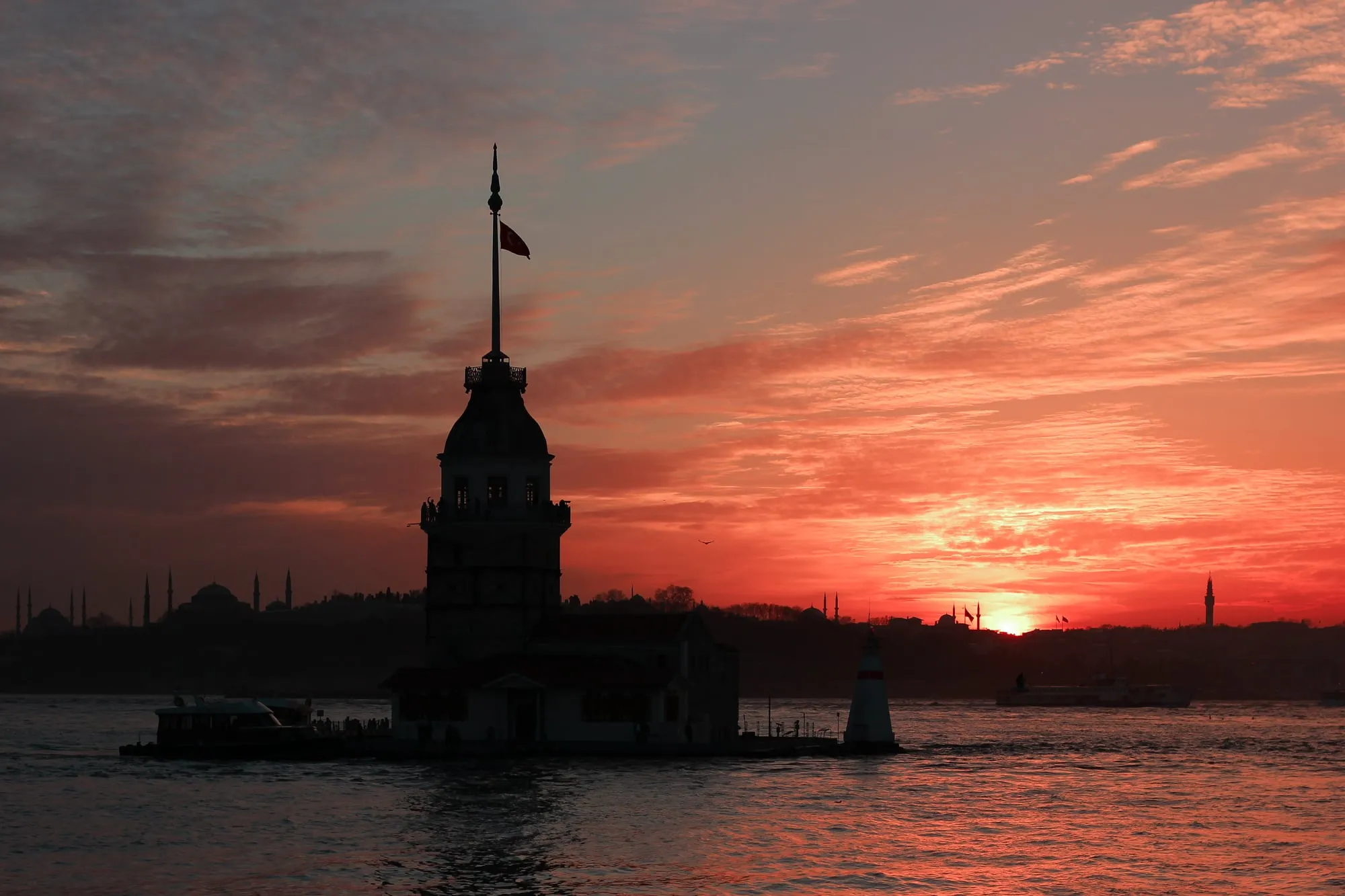
Almost every photograph of Istanbul that shows water somewhere in the frame ends up including a small stone tower standing alone on a rock. That is Kız Kulesi — the Maiden's Tower — and it sits roughly 200 metres off the Asian shore, at the point where the Bosphorus opens into the Sea of Marmara.
See the Tower Lit From the Strait
Our evening Bosphorus cruise passes the Üsküdar shore where the tower stands, with dinner, live music and traditional shows on board. Pay on the boat — no card details, no prepayment. See the cruise →
It is the only building in Istanbul that is completely surrounded by water, and it has been rebuilt so many times over twenty-four centuries that almost nothing of the original survives. What follows is what the tower actually is, why it carries that name, and the practical part — how to get out to it, and where to stand if you want the photograph.
Where the Tower Is
The islet lies off Salacak, in the Üsküdar district, on the Asian side of Istanbul. Look at it on a map and you will see why the spot was chosen: it sits almost exactly at the narrow mouth of the strait, within sight of both continents. Anything sailing between the Black Sea and the Mediterranean has to pass it.
That geography is the whole story of the building. Every civilisation that controlled Istanbul put something on that rock, because whoever holds it can see — and historically, tax or block — everything that moves through the strait.
2,400 Years of Rebuilding
The tower is old, but the building you see is not. It is better understood as a series of structures on the same rock.
408 BC — a customs post
The first recorded structure was raised by the Athenian general Alcibiades, who needed a control point to monitor Persian shipping entering the strait. It was a toll station more than a fortress — the ancient equivalent of a border checkpoint in the middle of a waterway.
1110 — the Byzantine fortress
Emperor Alexios I Komnenos built a wooden tower on the islet and ran an iron chain from it to a second tower on the European shore. The chain could be raised to close the strait to enemy ships — the same defensive trick Constantinople used across the Golden Horn.
1763 and 1832 — the Ottoman tower
After repeated fires destroyed the wooden structures, the tower was rebuilt in stone in 1763. The silhouette most people recognise — the tapering body and the pointed cap — comes from an 1832 restoration under Sultan Mahmud II, which gave the building its Ottoman baroque character.
Since then it has worked as a lighthouse, a quarantine station during a cholera outbreak, a naval signalling post, and a radio station. It has been a restaurant, a film location, and — since its most recent restoration — a museum.
The Legends Behind the Name
The Turkish name means "maiden's tower", and the story attached to it is one of the most repeated in Istanbul.
A sultan — or in older versions, a Byzantine emperor — is told by a soothsayer that his daughter will die of a snakebite before her eighteenth birthday. To keep her away from every snake on land, he has a tower built on a rock in the sea and shuts her inside. On her eighteenth birthday, relieved that the prophecy has passed, he sends her a basket of fruit as a gift. A viper is hidden among the fruit. She dies exactly as foretold.
There is a second name in circulation: Europeans have long called it Leander's Tower, after the Greek myth of a young man who swam a strait nightly to reach his lover Hero, and drowned when the guiding light went out. That myth actually belongs to the Dardanelles, not the Bosphorus — a confusion that stuck to this building and never came off. If you see "Leander's Tower" on an old map or an English-language sign, it means this tower.
Inside the Tower Today
The tower closed for a major structural restoration and reopened in May 2023. The work went deep — the rock and the foundations were reinforced, and later additions were stripped back.
Inside, it now functions as a small museum: the history of the islet, archaeological finds, and displays on the tower's various working lives. The upper level has a café and a viewing terrace, and the terrace is the point. You are standing in the middle of the strait, and Istanbul is arranged in a full circle around you — Topkapı and the Hagia Sophia skyline on one side, the Asian shore on the other, ships passing close enough to read their names.
It is a small building. Allow an hour or so, plus the boat time.
How to Visit
There is no bridge or causeway. The only way to reach the islet is by boat, and the boats run as a shuttle service.
- From Salacak (Üsküdar), Asian side — the shortest crossing, a few minutes on the water. Reach Salacak by Marmaray or the M5 metro to Üsküdar, then a short walk along the shore.
- From Kabataş, European side — a longer crossing, and useful if you are already on the European shore. Kabataş is served by the T1 tram and the F1 funicular from Taksim.
A few practical notes worth knowing before you set out:
- Entry to the tower and the boat transfer are handled together at the boarding point — check the current timetable and fare on the day, as both change seasonally.
- Crossings can be suspended in strong southerly winds (lodos). This is the single most common reason a visit falls through, and it is worth a check if the weather looks rough.
- The last boat back leaves earlier than most people expect. Confirm the return time when you board rather than assuming.
- The islet is small, uneven and reached by a boat step — mobility access is limited.
Best Photo Spots
The tower is more photogenic from the shore than from the islet itself — once you are on it, you cannot see it.
- Salacak promenade, Üsküdar — the classic angle, and the closest. At sunset the tower is a silhouette against the old city skyline behind it. This is the shot most people are looking for.
- Üsküdar waterfront near the ferry pier — slightly further back, which lets you frame the tower with passing ferries for scale.
- Seraglio Point (Sarayburnu), European side — the long view across the water, with the tower small in the frame and the whole strait around it.
- The evening ferry between Kabataş and Üsküdar — a cheap, moving vantage point that most visitors never think to use.
On timing: the tower is floodlit after dark, and the twenty minutes just after sunset — while there is still colour in the sky but the lights are already on — are the best of the day. Photographing it in flat midday light is the one thing worth avoiding.
Seeing It From the Water
There is a third way to see the tower, and it is the one most visitors miss: from the strait itself, at night, without getting off anywhere.
Our evening Bosphorus cruise runs the full length of the strait and comes back down the Asian shore through Kuzguncuk and Üsküdar — the stretch of water the tower stands in. It is lit, the boat is close, and unlike the daytime shuttle you see it in the context it belongs to: the bridges behind it, the palaces on the opposite bank, the city on both sides at once.
If you are choosing between visiting the tower and seeing it lit from the water, they are genuinely different experiences. The museum gives you the history. The night passage gives you the reason it was built there in the first place.
See the Tower Lit From the Strait
Our evening Bosphorus cruise passes the Üsküdar shore where the tower stands, with dinner, live music and traditional shows on board. Pay on the boat — no card details, no prepayment.
See the cruise →Frequently Asked Questions
Why is it called the Maiden's Tower?
The name comes from a legend: a ruler was warned by a soothsayer that his daughter would die of a snakebite, so he had a tower built on a rock in the sea to keep her away from land. On her eighteenth birthday a viper hidden in a basket of fruit reached her anyway. Europeans have also long called it Leander's Tower, but that myth actually belongs to the Dardanelles, not the Bosphorus.
How do you get to the Maiden's Tower?
Only by boat. Shuttle boats run from Salacak in Üsküdar on the Asian side — the shortest crossing, a few minutes — and from Kabataş on the European side. There is no bridge or walkway. Crossings can be suspended in strong southerly winds, so it is worth checking conditions before you set out.
Can you go inside the Maiden's Tower?
Yes. The tower reopened in May 2023 after a major structural restoration and now works as a small museum, with a café and a viewing terrace on the upper level. It is a compact building — around an hour inside is enough, plus the boat crossing each way.
How old is the Maiden's Tower?
The first structure on the islet dates to 408 BC, when the Athenian general Alcibiades built a customs post to monitor shipping. But the building standing today is far younger: it was rebuilt in stone in 1763 after repeated fires, and its recognisable silhouette comes from an 1832 restoration under Sultan Mahmud II.
What is the best place to photograph the Maiden's Tower?
The Salacak promenade in Üsküdar is the classic angle and the closest — at sunset the tower reads as a silhouette against the old city skyline. For a wider view, Seraglio Point on the European side shows the tower within the whole strait. The best light is the twenty minutes after sunset, when the tower is floodlit but the sky still has colour.
Continue exploring
Dolmabahçe Palace Guide
The palace on the opposite shore — 285 rooms, a 4.5-tonne chandelier, and clocks stopped at 09:05.
Bosphorus Bridges Guide
All three suspension bridges: history, lighting, and where to see them from.
Best Photo Spots on the Bosphorus
Twelve locations with timing tips for each.
Things to Do in Istanbul at Night
Ten local picks for after dark.