
The Turkish Night Show, Act by Act
In this article
"Traditional Turkish folk dances and a belly dance" is how most dinner cruises describe their evening, and it undersells what is actually on the stage. The programme runs in eight acts and moves across several distinct traditions — Central Asian, Anatolian, Caucasian, Ottoman — that happen to meet in Istanbul.
Here is what each one is and where it comes from.
The Eight Acts
Oba Dombra
Central Asian shaman rhythm, played on the two-stringed dombra
Mevlâna — the sema
Whirling dervish ceremony of the Mevlevi order, Konya, 13th century
Sarı Gelin
Anatolian folk dance, from a song shared across Turkish, Armenian, Azerbaijani and Persian traditions
Azerbaijani potpourri
Caucasus folk repertoire — faster and more upright than the Anatolian style
Oriental show
Belly dance, descended from Ottoman court and urban entertainment
Turkish and Anatolian potpourri
Several regional folk styles in quick succession
Georgian Gandagan and Caucasus potpourri
Georgian dance, including the knife sequence — thrown and caught in rhythm
After: live saxophone and DJ
Not traditional — the last stretch of the evening, on the return leg
The running order shifts from evening to evening, so we do not promise a particular act at a particular moment.
Oba Dombra — the Central Asian Opening
The evening does not open with anything Turkish in the Anatolian sense. It opens further east.
The dombra is a two-stringed long-necked lute from the Central Asian steppe — Kazakh and Turkic, played with a fast strummed right hand that produces a driving, percussive rhythm. What you hear is closer to a shamanic drum pattern than to a melody, and it is deliberately the first thing you hear.
The point of opening here is historical. The Turkic peoples came into Anatolia from Central Asia, and starting the evening with a steppe rhythm places everything that follows in that longer line rather than treating "Turkish" as something that began at the Bosphorus.
The Dervish Ceremony
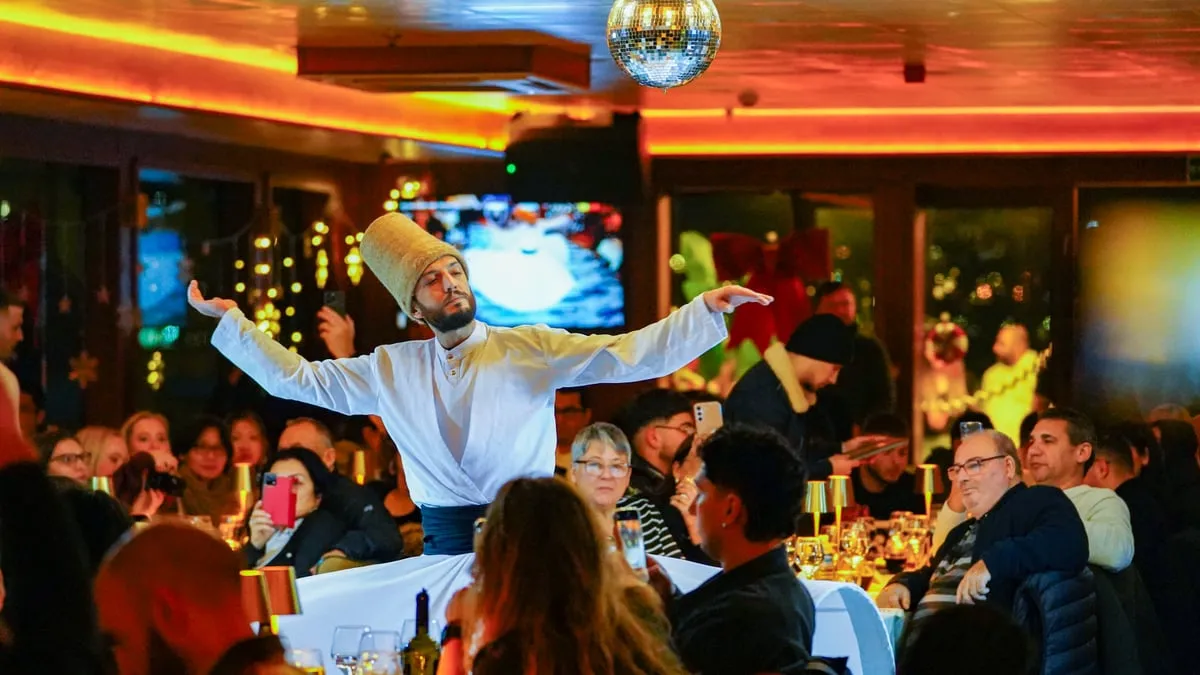
The second act is the sema — the whirling ceremony of the Mevlevi order, founded in Konya in the thirteenth century by the followers of Mevlâna Celâleddîn-i Rûmî.
It is not a dance, and it is worth knowing that before you watch it. It is a form of worship. The turning is a meditation: the dervish rotates on the left foot, right hand turned upward to receive, left hand turned down to pass on, the tall felt hat representing the tombstone of the ego and the white skirt its shroud. The rotation is what stays with people — controlled, unhurried, going on far longer than seems possible.
The convention among audiences is not to clap during it. Applause comes at the end, and many people find the quiet is what makes it.
Sarı Gelin and the Anatolian Dances
Sarı Gelin — "the blonde bride" or "the yellow bride", depending on how you read it — is one of the most widely shared songs in the region. Turkish, Armenian, Azerbaijani and Persian traditions all claim versions of it, which tells you something about how these cultures actually sit together rather than apart.
Danced here in the Anatolian folk idiom, it is performed in costume: linked lines, small precise steps, the whole line moving as one body rather than as individuals. Later in the programme a broader Turkish and Anatolian potpourri picks up several regional styles in quick succession.
Azerbaijan and the Caucasus
Two acts come from the other side of the Black Sea.
The Azerbaijani potpourri is closely related to the Anatolian material but faster and more upright, with the sharp shoulder and wrist work that marks the Caucasus style.
The Georgian Gandagan is the one people film. Georgian dance is famous for men dancing on the tips of the toes, without blocked shoes, and for the knives — the knife sequence in this act is genuine choreography from that tradition, thrown and caught in rhythm. It is the loudest few minutes of the evening.
The Belly Dance
The oriental dance — oryantal in Turkish, and known internationally as belly dance — is the act most people expect, and the one most misunderstood.
What it descends from is Ottoman court and urban entertainment, and technically it is far harder than it looks: the isolation of the hips and ribcage while the upper body stays composed takes years. Watch the shoulders and the hands rather than the hips and you will see the discipline in it.
The dancer comes down among the tables at some point. That is part of the form, not an interruption of it.
Saxophone and DJ
After the programme finishes, the register changes completely: a live saxophone, then a DJ set for the rest of the return leg.
This is the part of the evening that is not about tradition at all. The tables clear, most of the room is up, and the boat comes back down the Asian shore with the city lit on both sides. Plenty of people spend it on the open deck instead, which is a perfectly good decision.
How to Watch It
- Where you sit changes what you get. Tables near the stage give you the show straight on; window tables give you the shoreline but put you side-on. If the programme is what you came for, board early or reserve a table near the stage in advance.
- Do not clap during the sema. It is worship, not a performance number. Applause at the end.
- The order changes. We do not promise a specific act at a specific time, and the sequence shifts from night to night.
- Photography is fine throughout, though the dervish ceremony reads better in video than in stills.
- The performances come to you. Several acts move among the tables, so an aisle seat is not a worse seat.
For where the show sits inside the evening as a whole, see the hour-by-hour account.
See It From a Table
Dinner, the eight-act show and the full Bosphorus route, every evening from Kabataş. Payment on the boat — no card details, no prepayment.
See the cruise →Frequently Asked Questions
What kind of show is on a Bosphorus dinner cruise?
Eight acts across several traditions: a Central Asian dombra rhythm, a Mevlevi whirling dervish ceremony, the Anatolian folk dance Sarı Gelin, an Azerbaijani potpourri, an oriental belly dance, a Turkish and Anatolian potpourri, a Georgian Gandagan with a knife sequence, and a live saxophone and DJ set to finish.
Is there a whirling dervish performance?
Yes — the sema is the second act of the programme, performed every evening. It is the whirling ceremony of the Mevlevi order, founded in Konya in the thirteenth century. It is a form of worship rather than a dance, and the convention is not to applaud during it.
How long does the show last?
It runs across the evening in eight acts rather than as one continuous block, spaced between the courses. We do not promise a particular act at a particular time — the running order shifts from evening to evening.
Is the belly dance appropriate for families?
Yes. The oriental dance on board is performed in the theatrical tradition — costumed, choreographed, and staged for a dining room with families in it. Children are on board most evenings and the programme is put together with that in mind.
Where should we sit to see the show?
Tables closer to the stage give you the performances straight on; window tables give you the shoreline but put you side-on to the stage. Boarding early lets you pick, and a table near the stage can be reserved in advance as an add-on. Several acts also move among the tables, so an aisle seat is not a worse seat.
Read on
What You Eat on a Bosphorus Dinner Cruise
Ten mezes, the hot starter, the four mains, the dessert — course by course.
A Bosphorus Dinner Cruise, Hour by Hour
The evening in the order it happens, from the pier and back.
Things to Do in Istanbul at Night
Ten local picks for after dark.
10 Things to Know Before Your Boat Tour
Practical notes for first-time Bosphorus cruisers.